There’s nothing new about using public information to identify business opportunities: it’s why lawyers chase ambulances and bankers phone lottery winners. But the Internet has exponentially grown the amount of data available and made it easily accessible. What’s needed to fully exploit this resource is technology that automates the end-to-end process of assembling the information, identifying opportunities, and delivering the results to sales and marketing systems.
Lattice Engines was founded in 2006 to fill this gap. The system scans public databases, company Web pages, and selected social networks to find significant events such as title changes, product launches, job openings, new locations, and investments. It supplements this with data from the clients' own systems including customer profiles, Web site visits, and purchases. It then looks at past data to find patterns which predict selected outcomes, such as making a first purchase, buying an additional product, or renewing. It uses these patterns to identify the best current prospects for each outcome, and makes the lists available to marketing systems or sales people. The sales people also see explanations of why each person was chosen, what they should be offered, and recommended talking points.

Each of these steps takes significant technology. Lattice Engines currently monitors Web sites of five to 10 million U.S. businesses, checking daily for changes. The system’s semantic engine reads structured texts such as management biographies and press releases, extracting entities and relationships but not trying to understand more subtle meanings such as sentiment. Clients specify blogs to follow, which receive similar treatment. The company also monitors Twitter, Facebook company pages, Quora, and LinkedIn profiles of people within each sales person’s network. Additional data comes from standard sources such as business directories and from special databases requested by clients. Information from all these sources is loaded into a single database available to all Lattice Engine clients.
Lattice Engines also imports data from the clients own systems, although of course this isn’t shared with anyone else. Again, there’s some clever technology needed to recognize individuals and companies across multiple sources. Lattice Engines doesn’t try to link personal and business identities for individuals.

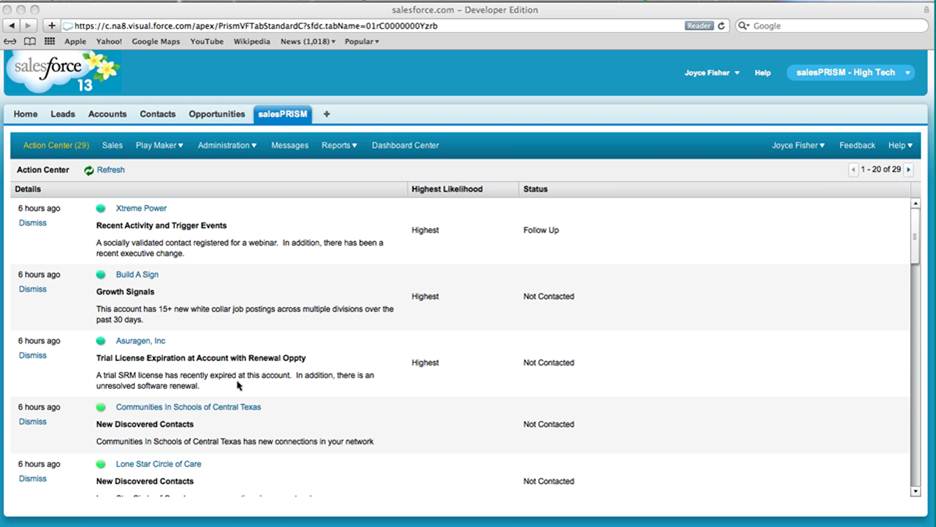
All this information is placed in a timeline so that modeling systems can look at events before and after the target activities. The models themselves are built automatically, once users specify the target activity, product, and time horizon. Users can then build a list of customers or prospects, have the model score it, and send high-ranking names to marketing or sales for further contact. Results can be exported to a marketing automation system or appear within the sales person’s CRM interface. Lattice Engines is directly integrated with cloud-based CRM from Salesforce.com, Microsoft Dynamics, and Oracle, and via file transfer with SAP CRM. Users can export lists to Excel and Marketo, with connectors for Eloqua and other marketing automation systems on the way.
The net result of this is a single system that performs all the tasks needed to exploit the wide range of information available about customers and prospects. Marketers could theoretically use separate systems for each step in the process, and integrate the results for themselves. But few really have the skills to do this. And, in most cases, it would be more expensive than purchasing a single system like Lattice Engines. It's particularly helpful that Lattice Engines supports both prospecting and customer management -- further reducing the need for multiple products, and further encouraging cooperation between marketing and sales departments.
Pricing for Lattice Engines starts at $75,000 per year and grows based on the number of data sources and sales users. Client data volume doesn't affect the cost, since Lattice Engines’ own databases are vastly larger than any client data. The company has close to 50 deployments, nearly all at large B2B marketers including Dell, HP, Microsoft, ADP, and Staples.
Lattice Engines was founded in 2006 to fill this gap. The system scans public databases, company Web pages, and selected social networks to find significant events such as title changes, product launches, job openings, new locations, and investments. It supplements this with data from the clients' own systems including customer profiles, Web site visits, and purchases. It then looks at past data to find patterns which predict selected outcomes, such as making a first purchase, buying an additional product, or renewing. It uses these patterns to identify the best current prospects for each outcome, and makes the lists available to marketing systems or sales people. The sales people also see explanations of why each person was chosen, what they should be offered, and recommended talking points.
Each of these steps takes significant technology. Lattice Engines currently monitors Web sites of five to 10 million U.S. businesses, checking daily for changes. The system’s semantic engine reads structured texts such as management biographies and press releases, extracting entities and relationships but not trying to understand more subtle meanings such as sentiment. Clients specify blogs to follow, which receive similar treatment. The company also monitors Twitter, Facebook company pages, Quora, and LinkedIn profiles of people within each sales person’s network. Additional data comes from standard sources such as business directories and from special databases requested by clients. Information from all these sources is loaded into a single database available to all Lattice Engine clients.
Lattice Engines also imports data from the clients own systems, although of course this isn’t shared with anyone else. Again, there’s some clever technology needed to recognize individuals and companies across multiple sources. Lattice Engines doesn’t try to link personal and business identities for individuals.

All this information is placed in a timeline so that modeling systems can look at events before and after the target activities. The models themselves are built automatically, once users specify the target activity, product, and time horizon. Users can then build a list of customers or prospects, have the model score it, and send high-ranking names to marketing or sales for further contact. Results can be exported to a marketing automation system or appear within the sales person’s CRM interface. Lattice Engines is directly integrated with cloud-based CRM from Salesforce.com, Microsoft Dynamics, and Oracle, and via file transfer with SAP CRM. Users can export lists to Excel and Marketo, with connectors for Eloqua and other marketing automation systems on the way.
The net result of this is a single system that performs all the tasks needed to exploit the wide range of information available about customers and prospects. Marketers could theoretically use separate systems for each step in the process, and integrate the results for themselves. But few really have the skills to do this. And, in most cases, it would be more expensive than purchasing a single system like Lattice Engines. It's particularly helpful that Lattice Engines supports both prospecting and customer management -- further reducing the need for multiple products, and further encouraging cooperation between marketing and sales departments.
Pricing for Lattice Engines starts at $75,000 per year and grows based on the number of data sources and sales users. Client data volume doesn't affect the cost, since Lattice Engines’ own databases are vastly larger than any client data. The company has close to 50 deployments, nearly all at large B2B marketers including Dell, HP, Microsoft, ADP, and Staples.


