Summary: Conversen makes it easy to generate dynamic messages across multiple channels. It's more a supplement than a replacement for conventional campaign management but should save a lot of work for marketers and their agencies.
One of the fundamental challenges in database marketing is that a seriously sophisticated campaign may send different messages to hundreds or even thousands of customer segments. The traditional approach has been to define these segments during the selection process, creating a tree with one end-point for each segment, and then to assign the appropriate message to each end-point. The problem is that this requires creating hundreds of versions of the messages and making sure that each is matched to the correct end-point. This is both labor-intensive and error-prone.
An alternative is to create "dynamic content" the messages that select the appropriate contents for each individual. In essence, this is moving some of the segmentation logic from the selection process to inside the message. Even though this ultimately produces the same number of variations, it lets marketers create fewer messages and segments, reducing manual effort.
Let’s take a concrete example. Suppose you’re sending offers for winter vacation travel. People in New York will be sent offers for Florida and people in Los Angeles will get offers for Mexico. In addition, people in high-income zip codes will be offered a deluxe package while those in middle-income zip codes get an economy offer. A segmentation-based approach would use three segmentation rules (New York or Los Angeles; if New York, high or middle income; if Los Angeles, high or middle income) to create four segments, each tied to a separate message. A dynamic content approach would require just two decisions (New York or Los Angeles, high or middle income) that are each tied to a specific content block.
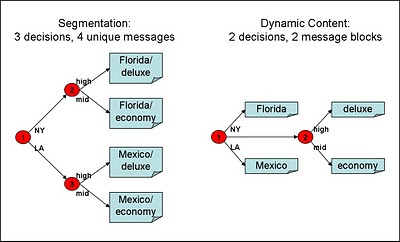
It’s still possible to make a mistake: you could accidentally link the Mexico offer to New York. But each assignment is made only once so it’s easier to be sure it’s correct.
Note that the advantage of dynamic content increases as you add complexity: a three city-pair, three level program would require four segmentation rules (one for city, three for city/level combination) and nine unique messages, while dynamic content still needs only two rules (one for city, one for level) and six message blocks (three destination cities, three luxury levels).

So where’s the catch? Well, dynamic content requires the marketing automation vendor to work inside the message itself, using different technologies for each medium. This is significantly trickier than just pointing each segment to a message created elsewhere.
One way to avoid this complexity is to generate a file containing the customer records and segmentation variables and let channel-specific output systems generate the customized messages. But this adds its own costs and risks, since the external systems must be configured separately for each project. As a practical matter, most high-end marketing automation vendors have compromised by providing dynamic customization for email and Web pages, and letting external systems handle the other channels.
Conversen has taken a different approach, building a specialized system to support dynamic content across as many channels as possible. This puts it in a somewhat confusing business position, since it can sometimes replace a traditional campaign management system but more often receives output from one. Resolving this confusion is largely Conversen's own problem, however, since it sells to marketing service providers rather than end-users.
Conversen is organized primarily around campaigns. These include filters to select an audience, processing steps and content. The key here is consistency: the rules used in filters, steps and dynamic content are exactly the same. It's not just that they're built with the same interface and run against the same data structures: the same rule can actually be used for any purpose. Rules can also be shared across multiple campaigns and referenced within other rules. This reuse substantially reduces the number of rules needed, and thus both the effort and opportunity for error.
The rules themselves are quite powerful, extending beyond the usual selections on field values to include advanced features such as if/then/else loops. One gap is missing support for a/b testing, which Conversen decided to omit because it added too much complexity. The system doesn’t maintain an audit trail of changes to each rule, but does provide reports listing everywhere each rule is used. This helps to avoid unintentional consequences when a rule is changed.
Rules connect with data gathered from source systems through batch processes or a real-time API. The resulting database is stored in Microsoft SQL Server and hosted by Conversen. This is important point, since it means that Conversen doesn’t simply attach to an existing marketing database. Although moving data into a separate database does add some cost, it also provides options to maintain persistent customer histories, combine data from multiple sources, and directly capture events such as campaign responses.
The system includes basic features to define data structures and map data from external sources into those structures. Load maps can include basic rules for whether to update or append matching records, but more advanced processes such as name/address matching have to be done externally.
Users who don’t need any of these functions could simply send Conversen the output files from a conventional campaign manager. This costs no more than loading files into any other message delivery system.
The heart of Conversen are the marketing messages. Conversen defines each message as an XML template. This holds any static elements plus the rules used to select content blocks.
The blocks themselves are created outside of Conversen and stored in a content library. This is another example of Conversen drawing the line between its core functionality and supporting functions to be handled elsewhere. It also probably reflects the reality that content will be created by external vendors, such as ad agencies, who will want to use their own tools in any event. Lack of an integrated content-builder does mean that personalization tokens such as [First Name] must be manually embedded within the content block. This can be done in the original content creation system, requiring a relatively inconvenient cut-and-paste from a list provided by Conversen, or be added after the content is loaded into Conversen.
Each Conversen content block currently supports a single medium. Thus, there would be separate content blocks for 10% discount in email, Web, direct mail, mobile and other types of messages. Conversen is working on multi-media content blocks that could be inserted into any medium. This would further simplify marketers’ lives.
One Conversen campaign can deliver multiple messages over time, based on dates such as a contract expiration or recent activity, or on events such as promotion responses. The system can react to qualifying events at regular intervals or in near-real-time as they are posted.
Clients can also build custom interfaces by direct access to the Conversen API. This lets them create branded systems and offer specialized portals with limited functionality. These might give designers access to the content-management features of the system, or make predefined campaigns to available to field offices.
Conversen supports email, mobile (SMS), RSS feeds such as blog posts, print, call center and Web. The system provides specialized services for each channel, such as rendering to preview emails and postal sorting for direct mail. Print output is integrated with Bitstream PageFlex, which supports direct output to high-speed printers. Conversen sends the digital messages itself and ships print and call center files to third parties for execution.
The system also provides operational reporting on campaign volume and responses. The reports are designed to provide activity information rather than detailed marketing analysis.
Conversen was introduced in 2007. The company now has about 25 marketing agencies as customers, serving more than 125 end clients. The system is offered only as a Conversen-hosted service. Pricing includes a $15,000 setup fee plus $1 to $20 per thousand messages based on volume and type.
One of the fundamental challenges in database marketing is that a seriously sophisticated campaign may send different messages to hundreds or even thousands of customer segments. The traditional approach has been to define these segments during the selection process, creating a tree with one end-point for each segment, and then to assign the appropriate message to each end-point. The problem is that this requires creating hundreds of versions of the messages and making sure that each is matched to the correct end-point. This is both labor-intensive and error-prone.
An alternative is to create "dynamic content" the messages that select the appropriate contents for each individual. In essence, this is moving some of the segmentation logic from the selection process to inside the message. Even though this ultimately produces the same number of variations, it lets marketers create fewer messages and segments, reducing manual effort.
Let’s take a concrete example. Suppose you’re sending offers for winter vacation travel. People in New York will be sent offers for Florida and people in Los Angeles will get offers for Mexico. In addition, people in high-income zip codes will be offered a deluxe package while those in middle-income zip codes get an economy offer. A segmentation-based approach would use three segmentation rules (New York or Los Angeles; if New York, high or middle income; if Los Angeles, high or middle income) to create four segments, each tied to a separate message. A dynamic content approach would require just two decisions (New York or Los Angeles, high or middle income) that are each tied to a specific content block.

It’s still possible to make a mistake: you could accidentally link the Mexico offer to New York. But each assignment is made only once so it’s easier to be sure it’s correct.
Note that the advantage of dynamic content increases as you add complexity: a three city-pair, three level program would require four segmentation rules (one for city, three for city/level combination) and nine unique messages, while dynamic content still needs only two rules (one for city, one for level) and six message blocks (three destination cities, three luxury levels).

So where’s the catch? Well, dynamic content requires the marketing automation vendor to work inside the message itself, using different technologies for each medium. This is significantly trickier than just pointing each segment to a message created elsewhere.
One way to avoid this complexity is to generate a file containing the customer records and segmentation variables and let channel-specific output systems generate the customized messages. But this adds its own costs and risks, since the external systems must be configured separately for each project. As a practical matter, most high-end marketing automation vendors have compromised by providing dynamic customization for email and Web pages, and letting external systems handle the other channels.
Conversen has taken a different approach, building a specialized system to support dynamic content across as many channels as possible. This puts it in a somewhat confusing business position, since it can sometimes replace a traditional campaign management system but more often receives output from one. Resolving this confusion is largely Conversen's own problem, however, since it sells to marketing service providers rather than end-users.
Conversen is organized primarily around campaigns. These include filters to select an audience, processing steps and content. The key here is consistency: the rules used in filters, steps and dynamic content are exactly the same. It's not just that they're built with the same interface and run against the same data structures: the same rule can actually be used for any purpose. Rules can also be shared across multiple campaigns and referenced within other rules. This reuse substantially reduces the number of rules needed, and thus both the effort and opportunity for error.
The rules themselves are quite powerful, extending beyond the usual selections on field values to include advanced features such as if/then/else loops. One gap is missing support for a/b testing, which Conversen decided to omit because it added too much complexity. The system doesn’t maintain an audit trail of changes to each rule, but does provide reports listing everywhere each rule is used. This helps to avoid unintentional consequences when a rule is changed.
Rules connect with data gathered from source systems through batch processes or a real-time API. The resulting database is stored in Microsoft SQL Server and hosted by Conversen. This is important point, since it means that Conversen doesn’t simply attach to an existing marketing database. Although moving data into a separate database does add some cost, it also provides options to maintain persistent customer histories, combine data from multiple sources, and directly capture events such as campaign responses.
The system includes basic features to define data structures and map data from external sources into those structures. Load maps can include basic rules for whether to update or append matching records, but more advanced processes such as name/address matching have to be done externally.
Users who don’t need any of these functions could simply send Conversen the output files from a conventional campaign manager. This costs no more than loading files into any other message delivery system.
The heart of Conversen are the marketing messages. Conversen defines each message as an XML template. This holds any static elements plus the rules used to select content blocks.
The blocks themselves are created outside of Conversen and stored in a content library. This is another example of Conversen drawing the line between its core functionality and supporting functions to be handled elsewhere. It also probably reflects the reality that content will be created by external vendors, such as ad agencies, who will want to use their own tools in any event. Lack of an integrated content-builder does mean that personalization tokens such as [First Name] must be manually embedded within the content block. This can be done in the original content creation system, requiring a relatively inconvenient cut-and-paste from a list provided by Conversen, or be added after the content is loaded into Conversen.
Each Conversen content block currently supports a single medium. Thus, there would be separate content blocks for 10% discount in email, Web, direct mail, mobile and other types of messages. Conversen is working on multi-media content blocks that could be inserted into any medium. This would further simplify marketers’ lives.
One Conversen campaign can deliver multiple messages over time, based on dates such as a contract expiration or recent activity, or on events such as promotion responses. The system can react to qualifying events at regular intervals or in near-real-time as they are posted.
Clients can also build custom interfaces by direct access to the Conversen API. This lets them create branded systems and offer specialized portals with limited functionality. These might give designers access to the content-management features of the system, or make predefined campaigns to available to field offices.
Conversen supports email, mobile (SMS), RSS feeds such as blog posts, print, call center and Web. The system provides specialized services for each channel, such as rendering to preview emails and postal sorting for direct mail. Print output is integrated with Bitstream PageFlex, which supports direct output to high-speed printers. Conversen sends the digital messages itself and ships print and call center files to third parties for execution.
The system also provides operational reporting on campaign volume and responses. The reports are designed to provide activity information rather than detailed marketing analysis.
Conversen was introduced in 2007. The company now has about 25 marketing agencies as customers, serving more than 125 end clients. The system is offered only as a Conversen-hosted service. Pricing includes a $15,000 setup fee plus $1 to $20 per thousand messages based on volume and type.


